Obsidian Markdown

Enter Obsidian’s “Daily Note” feature. Your “Daily Notes” create a space for ephemeral thoughts and ideas. The folder is an easily accessible catch-all. It’s an “inbox” to capture. Format your notes - Powered by Obsidian Publish. Interactive graph. Table of contents.
Over the years, I’ve accumulated thousands of notes and a personalized GTD system (with tags and notebooks) in Evernote. I use my own flavor of the Zen to Done method, where I capture pretty much everything (from recipes to articles to read, and from project notes to grant deadlines). I’ve come to heavily rely on this second brain, both professionally and personally.
Evernote has served me well for almost a decade. However, the latest update is so annoying (app is super slow, note export to html gone, ) I’m planning to abandon ship. For now, I’ve downgraded to the last useable version on my devices (thanks, reddit!). Getting some great advice from Twitter, I decided that this is the time to invest in a note-taking solution that’s sustainable for the future.
Taking a step back, these are must-have features for me:
#Obsidian #Obsidianapp #Obsidiannotetakingapp☕ Buy Me A Coffee - video shows. You how to create custom diagram. This Markdown cheat sheet provides a quick overview of all the Markdown syntax elements. It can’t cover every edge case, so if you need more information about any of these elements, refer to the reference guides for basic syntax and extended syntax. Some awesome suggestions here. And gold information pointing out that markdown supports HTMl completely! A good clean solution is always to go with pure html syntax for sure. But I was trying to still stick to the markdown syntax so I tried wrapping it around a tag and added whatever attributes i wanted for the image inside the.
- Sustainable format, i.e. avoid locking myself into another app that may break or change in ways I don’t like. I’d like to avoid repeating this ordeal in a few years from now.
- Import from Evernote (.enex or .html) – I have way too many notes to manually port them
- Quick capture across devices
- Single text note for brain dumps should be very quick on phone and laptop
- Web clipping
- Email forwarding
- Organizing with tags and notebooks (and ideally cross-linking notes)
- Shortcuts or saved searches to different combinations of tags
- Embedding figures (and other attachments)
- Good search
- Some additional features (e.g. Kanban-style project management, reminders) would be a plus, not a must
Based on excellent advice from a number of people on Twitter (thanks!), I looked at a couple of apps. Here’s a quick comparison:
While Notion, Roam and Bear all look very beautiful, I decided against these to avoid future vendor lock-in. Dynalist lacks Evernote import, making it a no-go for me. I reviewed Joplin, an open-source replacement for Evernote. It has the same look and feel, and allows for seamless import of .enex files. However, the interface is pretty bare-bones and I was curious to use this opportunity to explore less linear kinds of note-taking.
Which brought me to the Zettelkasten method, and the Obsidian and Zettlr apps. Both are essentially a layer on top of a folder of Markdown files. Markdown is unlikely to go anywhere soon, and the notes can be synced in any way you like: I put them in my Dropbox folder.
First step: export my Evernote files to Markdown
- Downgrade to Evernote 6 (the newer, awful v10 doesn’t allow export of more than 50 notes as a time)
- Export each notebook as a .enex file, making sure to click the ‘export tags’ checkbox
- Use this excellent converter to export all of these notes to Markdown: https://github.com/akosbalasko/yarle
- See here https://github.com/anne-urai/yarle for the template and config settings I used
- This worked beautifully, and converted all my notes (but took a while for ~7GB worth of .enex files)
Web clipping to Markdown
The Markdownload plugin https://github.com/deathau/markdownload clips webpages to a Markdown file, which should go into the Inbox folder with notes. I used the following settings on the plugin, to ensure that clipped and exported notes have the same structure:
I also turned off image downloads – Obsidian beautifully renders web images, and I figured this would reduce note size considerably. It does come at the risk of breaking in the future, but for most images that I clip from the web that’s OK.
Organize Obsidian
Between Zettlr and Obsidian, I picked the latter (but they seem very similar and can both access the same structure of files).

To rebuild some of my Evernote workflow, I enabled the ‘Zetttelkasten prefixer’ and ‘Calendar’ plugins. The former allows creating a quick note with a Zettelkasten prefix (YYYY-MM-DD_HH:MM:SS) and a template structure (e.g. date created and updated), and the latter launches a daily/weekly/monthly note from a template (with goals, projects worked on, habit tracker).
To create a simple Kanban list, I used the following useful template https://github.com/masonlr/obsidian-starter-templates#kanban-with-embeded-queries which organizes notes (by tags) in a table.
I also starred some important ‘meta’ notes and saved searches.
Email forwarding: IFTTT + Automator
I have a habit of forwarding important reference emails, or emails containing tasks to do, to my GTD inbox for both safekeeping and project management. Obsidian doesn’t have an email forwarding setup, but I hacked together the following:
Obsidian Markdown
- on IFTTT, select ’email’ as trigger, and pick ‘Send IFTTT any email’. This will give you the trigger@applet.ifttt.com email address, to which you can forward emails.
- warning: if you have multiple inboxes (home, work, etc) this will only work when you send from the email address associated with your IFTTT account. In my case, this is my gmail. I could probably add an IFTTT account for each of my email inboxes, like my work email.
- this email will trigger Dropbox (where I keep my Obsidian Markdown database) to create a text file. I used the following Markdown syntax
- Unfortunately, this will append a
.txtextension to the file you’ve just created (which is not recognized by Obsidian). On Mac, we can build an automator workflow: it will monitor the Inbox folder for files called .md.txt, and remove the .txt extension.
Missing features
Obsidian doesn’t have a mobile app, so ubiquitous capture (for quick ideas) is tricky. For now, I’m going to use Google Keep as an inbox on my phone, and process that one daily.
tl;dr Turns out, the structure of all of my second brain is rather pretty!
You can write content using GitHub-flavored Markdown syntax.
#Markdown Syntax
To serve as an example page when styling markdown based Docusaurus sites.
#Headers
Obsidian Markdown Sync
#H2 - Create the best documentation
#H3 - Create the best documentation
#H4 - Create the best documentation
#H5 - Create the best documentation
#H6 - Create the best documentation
#Emphasis
Emphasis, aka italics, with asterisks or underscores.
Strong emphasis, aka bold, with asterisks or underscores.
Combined emphasis with asterisks and underscores.
Strikethrough uses two tildes. Scratch this.
#Lists
- First ordered list item
- Another item ⋅⋅* Unordered sub-list.
- Actual numbers don't matter, just that it's a number ⋅⋅1. Ordered sub-list
- And another item.

⋅⋅⋅You can have properly indented paragraphs within list items. Notice the blank line above, and the leading spaces (at least one, but we'll use three here to also align the raw Markdown).
⋅⋅⋅To have a line break without a paragraph, you will need to use two trailing spaces.⋅⋅ ⋅⋅⋅Note that this line is separate, but within the same paragraph.⋅⋅ ⋅⋅⋅(This is contrary to the typical GFM line break behaviour, where trailing spaces are not required.)
- Unordered list can use asterisks
- Or minuses
- Or pluses
Obsidian Note Taking
#Links
Or leave it empty and use the link text itself.
URLs and URLs in angle brackets will automatically get turned into links. http://www.example.com or http://www.example.com and sometimes example.com (but not on Github, for example).
Some text to show that the reference links can follow later.
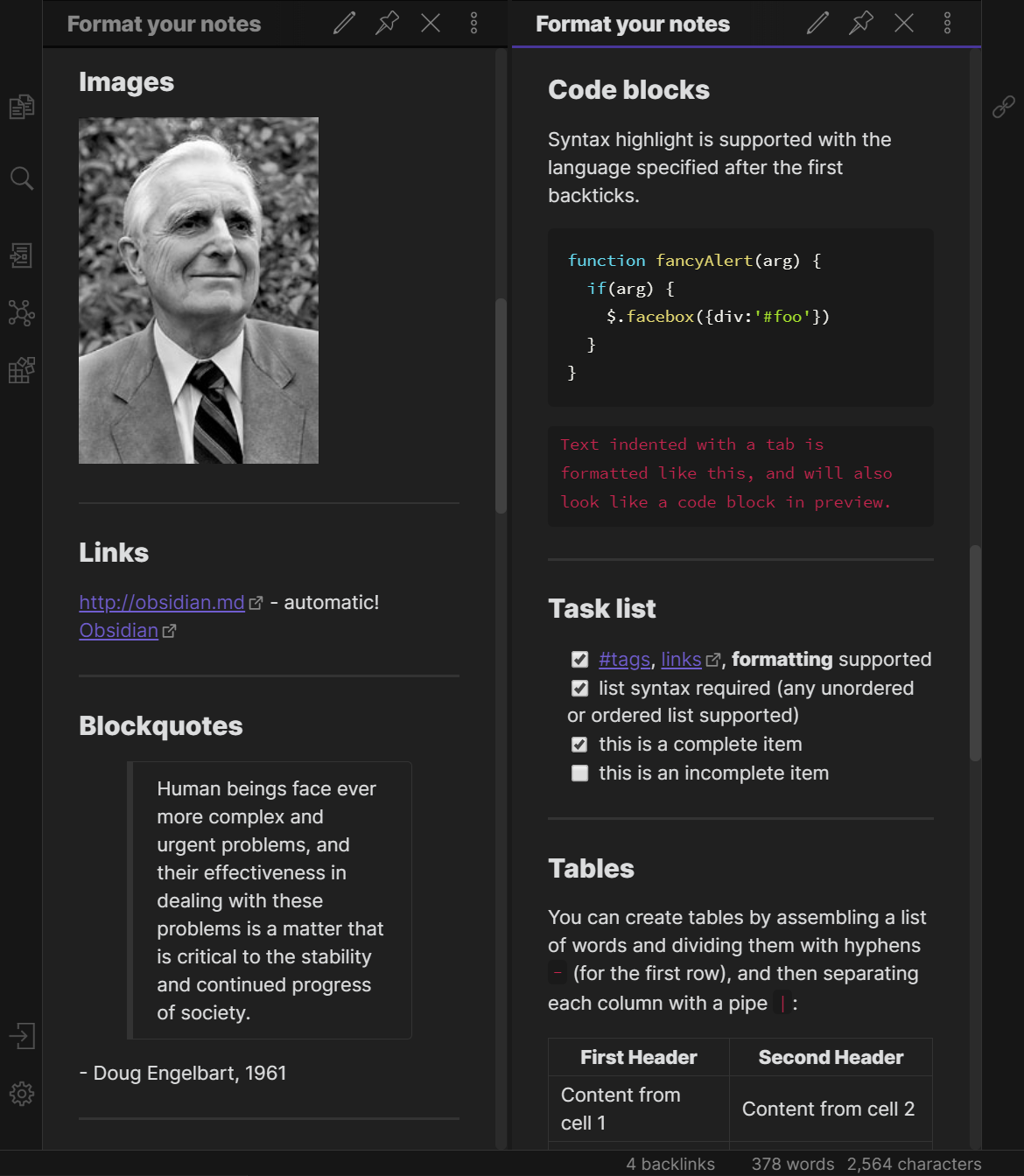
#Images
Here's our logo (hover to see the title text):
Inline-style:
Reference-style:
#Code
#Tables
Colons can be used to align columns.
| Tables | Are | Cool |
|---|---|---|
| col 3 is | right-aligned | $1600 |
| col 2 is | centered | $12 |
| zebra stripes | are neat | $1 |
There must be at least 3 dashes separating each header cell. The outer pipes (|) are optional, and you don't need to make the raw Markdown line up prettily. You can also use inline Markdown.
| Markdown | Less | Pretty |
|---|---|---|
| Still | renders | nicely |
| 1 | 2 | 3 |
#Blockquotes
Blockquotes are very handy in email to emulate reply text. This line is part of the same quote.
Quote break.
This is a very long line that will still be quoted properly when it wraps. Oh boy let's keep writing to make sure this is long enough to actually wrap for everyone. Oh, you can putMarkdown into a blockquote.
#Inline HTML
- Definition list
- Is something people use sometimes.
- Markdown in HTML
- Does *not* work **very** well. Use HTML tags.
#Line Breaks
Here's a line for us to start with.
This line is separated from the one above by two newlines, so it will be a separate paragraph.
This line is also a separate paragraph, but... This line is only separated by a single newline, so it's a separate line in the same paragraph.